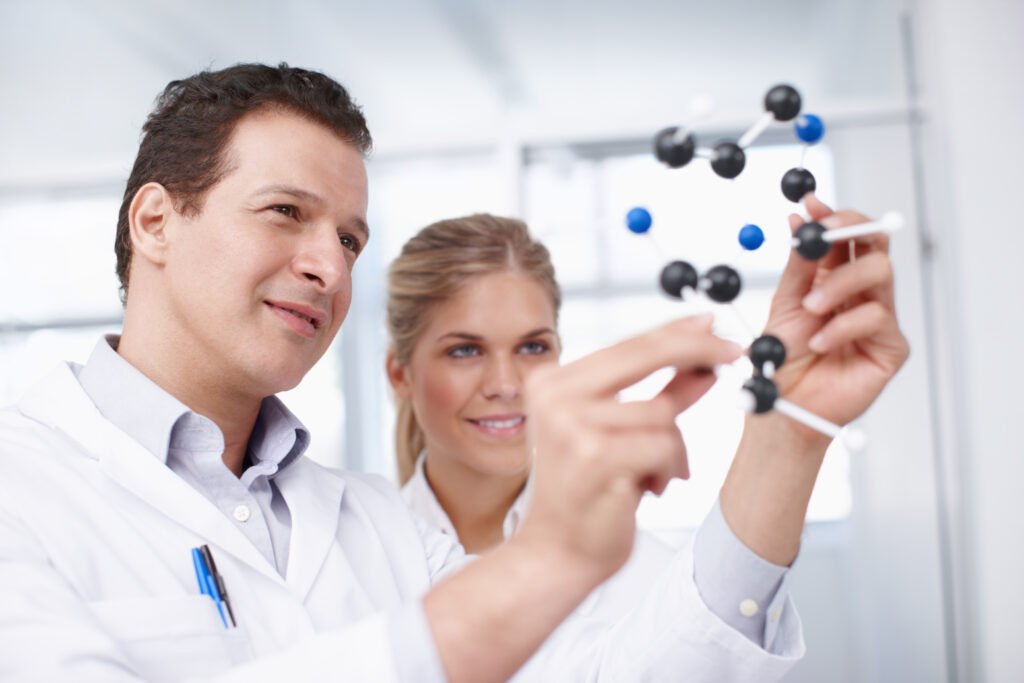
Models help us bring into focus features of science that are challenging to observe. You should recognize their assumptions and limitations, and evaluate and refine them by comparing their predictions with the real world. When new evidence is uncovered, models are refined.
Models include diagrams, physical replicas, mathematical representations, analogies, and computer simulations. Although models do not correspond exactly to the real world, they bring certain features into focus while obscuring others. All models contain approximations and assumptions that limit the range of validity and predictive power, so it is important for students to recognize their limitations. In science, models are used to represent a system (or parts of a system) under study, to aid in the development of questions and explanations, to generate data that can be used to make predictions, and to communicate ideas to others. Students can be expected to evaluate and refine models through an iterative cycle of comparing their predictions with the real world and then adjusting them to gain insights into the phenomenon being modeled. As such, models are based upon evidence. When new evidence is uncovered that the models can’t explain, models are modified. In engineering, models may be used to analyze a system to see where or under what conditions flaws might develop, or to test possible solutions to a problem. Models can also be used to visualize and refine a design, to communicate a design’s features to others, and as prototypes for testing design performance.
Mastery of this Practice includes
Evaluate merits and limitations of two different models of the same proposed tool, process, mechanism or system in order to select or revise a model that best fits the evidence or design criteria.
Develop and/or use multiple types of models to provide mechanistic accounts and/or predict phenomena, and move flexibly between model types based on merits and limitations.
Design a test of a model to ascertain its reliability.
Develop a complex model that allows for manipulation and testing of a proposed process or system.
Develop and/or use a model (including mathematical and computational) to generate data to support explanations, predict phenomena, analyze systems, and/or solve problems.